Thursday, May 2, 2013

I wrote a blog about some stuff

***Note***
This blog is best read whilst enjoying this song: http://www.youtube.com/watch?v=0JGHI4TAC5U
It also helps if you time your reading so that you're about halfway done at around 1:05 in the song

What a swell year for blogs it has been. This year fulfilled my long desire to feel like a pretentious writer who blogs all the time and makes their people/family feel bad for not reading them. I feel as if I was able to make a real change in world events through my gritting and unrelenting blogs with such topics as: English, books, and even more English. Blogs mainly served as a way for me to reflect on the weeks happenings with relation to our class. Many things that we did seemed fairly laborious or boring at the time. (Talking about you Beloved and any in-class essay). But come blog time I was able to reflect on these tasks in a more positive light. Sure, reading Beloved may have been one of the worst experiences I've ever had reading a book. But blogs allowed me to reflect on my qualms and realize that I had much to gain from these tortures. Blogging about my ever lasting love for in-class essays helped me realize that many of my problems with those guys were intrinsic to me and could not be blamed entirely on the prompts. Blogging also provided additional opportunities for me to ponder on my independent reading books. Since everyone got to choose their independent reading books it meant that there was no time to discuss each specific novel in class. However, I could blog about my books and make realizations that weren't present in my initial reflections. I would also say how reading my fellow classmates blogs exposed me to a wide range of unique and diverse perspectives and helped me culture a greater appreciation for individualism but then I would be a filthy liar. I seemed to be notorious for forgetting to read other people's blogs so sorry about that other people.
Also, blogs=free points=profit?

I wanted to end this final blog on some super profound/emotional note but I really suck at those things and ain't nobody got time for that. So here's the next best thing: a photo of a guinea pirate of course. Nature's most feared animal/pirate hybrid.

Thursday, April 25, 2013

sometimes I think no one reads these things, so I wanna put really dumb stuff for the title to see if anyone notices

The subject of this particular blog tonight is is something I think deserves everyone's appreciation: music in movies. Normally, when I'm watching a movie,  music is the one of the last things that I tend to notice. It's something that usually isn't in the foreground and plays more of a support role. However, without music, films would be absolutely abysmal. I was thinking about this recently as I've been nerding it up this week and watching The Lord of the Rings film series again. Howard Shore, the composer for the trilogy, is able to capture the emotions of what is happening in a particular scene and translate each feeling into music in a remarkably beautiful way. His music isn't something that you consciously hear as you watch the movies. It is something that you feel. Often the music is in the background and seeks to only enhance the emotions of each scene. This is exactly what I think music in movies should strive to accomplish. However, what is so brilliant about his composing is that he knows when to make the music the audiences main focus. This is often done in battle scenes or when there is little dialogue between the characters.  The music makes what the actors are doing something more. Their is a greater sense of what is happening could be real and isn't just being acted out by full grown men in make up.


This song perfectly exemplifies how Howard Shores composing is able to make a scene feel like more then just a movie

http://www.youtube.com/watch?v=sAb-fqBrUsY

Thursday, April 18, 2013

Space is a Pretty Cool Place

So if I'm not mistaken I recall you saying that we could occasionally have a few blogs that weren't totally related to English. And seeing as my recent blogs have been the paragon for all blogs I figured I would be a hipster and deviate away from the mainstream blog posts. Anyway, I came home today and was perusing the google news website and found an intriguing article in the science section. This one to be exact: http://www.space.com/20720-earth-like-alien-planets-discovery.html
For those of you without computers but who are still somehow reading this blog I will elaborate on what the article says. Basically,  it says "Science is like the coolest freaking thing ever and we should all do sciency stuff all the time because that would be rad". But actually, apparently 3 planets were discovered outside of our solar system that may have the perfect conditions for life. The zone in which these type of planets exist is known as the "habitable zone" and is considered a place where theoretically, and on a large enough time line, life should be able to evolve. The star around which these planets is 7 billion years. By comparison, our sun is roughly 5 billion years old, so these planets have had ample time to develop life. Of course this solar system is 1200 light years away so we'll never be able to visit it in my lifetime. But it is encouraging to think that life on other planets seems to be an almost inevitable event, especially when you realize the sheer amount of galaxies and solar systems in our universe. 


 SCIENCE!!!! WOOOOO!!!!!!

Diagram of Kepler-62 Planetary System

Thursday, April 11, 2013

Hobbitssss

So I finished my third and final independent reading novel a couple of weeks and this of course meant only one thing: I could finally start reading The Hobbit!!!! I was finally able to open this beautiful book that had been left unattended next to my bed for nearly 4 months. I understand that The Hobbit probably isn't the most demanding book to read, but it's definitely better then reading nothing. I was especially interested in trying this book after I saw the film adaptation and thought "Wow, that kinda sucked." I was certain that Tolkien had written a better novel then that which was portrayed in the movies. And of course, I was right. I'm only 136 pgs into this book so far but I've read more then enough to form an opinion on it. When I first began this novel I noticed something about Tolkiens writing style. It was oddly simple in a way that brilliantly worked with the events occurring. I'm pretty sure that Tolkien initially wrote The Hobbit to be a children's book and this perhaps explains the more simplistic diction. This is of course, not to say that his writing style is inherently bad. Tolkien presents himself as an author who doesn't need to prove his merit through long ACT words and convoluted sentences that are free from order and relevance. Instead, he describes through an omniscient eye what is happening, using only words that a child could understand, but that a young adult could still appreciate. The Hobbit is a book rich in imagery and detail that finds the most adequate ways to depict a seemingly simple tale of adventure. It is also very different from the film. Mostly, in that unlike the movie, the first hour of the book isn't a dinner party

Thursday, March 28, 2013

rant about drugs and stuff

For my final independent reading novel I chose DMT:The Spirit Molecule: A Doctor's Revolutionary Research into the Biology of Near-Death and Mystical Experiences. This books focuses primarily on the psychedelic Dimethyltryptamine: an incredibly potent drug that immerses the user in a brief, but profound glimpse at another reality. I chose this novel because I had seen a documentary based on this novel on Netflix and was intrigued by this relatively unknown substance. What interested me even more was the claims that the author, Rick Strassman, made about this particular drug. Basically, he believes that DMT occurs naturally in the brain in the pineal gland. He makes this claim by asserting that tryptophan, an amino acid that is found in all living things, can synthesize with two other enzymes in the brain to form tryptamine, an essential component necessary to form DMT. I thought it was absolutely fascinating that an incredibly powerful psychedelic like DMT was produced naturally in the human brain. But then I actually read the book. In this book Strassman explains how DMT could potentially formed in the brain and what implications this would have on people's lives. From 1990-1995 he injected nearly 60 volunteers with DMT and studied its subsequent effects on the users. The effects of the drug could be felt in the volunteers only 30 seconds after the injection. The user would then see an array of geometric patterns and lights in the test room before being essentially transported to another realm. They would report encountering anthropomorphic beings who guided them throughout their trip. These beings would often communicate with the volunteers through non-verbal means and would grant them some new insight on life. This entire encounter lasted around 5-10 minutes to Strassman but appeared to be a lifetime to the patients. Strassman likened these events as being analogous to near-death experiences. He believes that endogenous DMT (DMT produced naturally in the brain) is released periodically through a persons life to assist them with stressful situations. This is where I started to think of everything in the book as completely ridiculous. Just because the necessary ingredients to synthesize DMT are produced in the brain doesn't mean it is actually created. And to speculate further on this erratic notion by claiming that this remarkably potent psychedelic is released throughout a persons life is naive and rash. soooo yeah. I was getting really tired of people saying that DMT is found in the brain when there is absolutely no discernible evidence to support that claim right now so I needed to get my rant in. but yeah, drugs are bad and what not so stay away from those pesky guys

Thursday, March 21, 2013

I found a way to use the word 'fortnight' in my blog tonight.

Normally when I'm in a sour mood books seem to be the last place I ever want to turn to (making book puns already). It often seems difficult for me to focus on reading when I'm perturbed and this only results in further frustration. However, I have started to wonder that this problem isn't attributed solely to that I'm reading, but what it is I'm reading. I'm sure there are many people in this world who can manage reading multiple books at once. Or those who can breeze through novel's and reading requirements as if they were nothing. I, however, am different. I don't allocate too much of my free time for literature and is therefore problematic for me to read multiple stories simultaneously or even finish a book in under a fortnight. This ties into my earlier point because much of what I read these days is required for this class. Of course I have some freedom in my choices (the 3 novels we could pick for the independent reading project), but these novels are all essentially the same and offer no especially unique idea's. So reading in relatively recent time periods, since school started, has not helped me deal with or alleviate problem's since I don't have much control over what I'm reading. Trying to read The Road whilst in a chipper mood is simply impossible. Reading Beloved without wanting to jam a stake through my eyes was also pretty hard. And trying to figure out what is happening in Emily Dickinson's mind as she writes her mood shattering poetry is torture. But reading books I get to choose definitely helps my attitude. I don't think the content or genre of the books I read for pleasure much matters. I thoroughly enjoy reading when I can do so at my leisure and have an interest in subject matter. This being said, I can't wait to finish any reading requirements we will have for this class. The Hobbit  has been gathering dust next to my bed for nearly 3 months since I haven't had time for it. I'm also interested in No Country for Old Men, Fight Club, maybe some more Cormac McCarthy and  Tolkien if I have time before college starts.

Thursday, March 14, 2013

Obligatory Poetry Blog

In class the other day I initially chose #19 from the list of definition's of poetry. This quote reads as "Poetry is not a turning loose of emotion, but an escape from emotion; it is not the expression of personality, but an escape from personality. But, of course, only those who have personality and emotion know what it means to want to escape from these things." I'm not sure why exactly I chose this quote. It just stood out to me. After much contemplation I decided that this quote meant that poetry isn't a form of expressing emotions; but instead a way to escape them. This of course only makes sense if you want to escape happiness for anger and frustration since poetry does nothing but annoy me. Another quote that really stuck out to me was the one by Isaac Newton: "(Poetry is) a kind of ingenious nonsense." I really liked this one because it describes exactly how I feel about the majority of poems that I read. At first glance, most poems seem vague and lack any inherent meaning. But upon further reading, it is usually likely to find implicit messages that were not visible before. Whether or not these messages were intended is often irrelevant since it only matters what people interpret it as. However, I still think that poetry is just a way for authors to string together incoherent and purposefully ambiguous phrases in hopes that people will mistake complexity for proficiency.

Thursday, March 7, 2013

Balls in Space: Random Blog about Spaceballs

I was torn on what to blog about tonight. I figured I could do the cliche blog about the end of Beloved  and how much I just absolutely adored that book, or write about my independent reading book and how that ties into my project. And then I thought "meh I could also just write about some movie cuz books are lame and stuff." But unlike my other blogs about movies ( There Will Be Blood/No Country for Old Men) this movie has close to zero literary significance or merit. But it's hilarious and would've fit into our satire mini-unit but I kinda forgot about it until just now. It's Spaceballs of course. The movie that made fun of Star Wars before it was cool. This movie is essentially 90 minutes of puns and terribly hilarious and obvious parodies about Star Wars and other prevalent sci-fi films of the times. What I love about this movie is how incredibly stupid it is. My dad made me watch it when I was young so of course I found all its immature humor appealing then. But even when I watched today I found myself dying at some of the jokes. I don't want to give too much away, but probably one of my favorites things about this movie is how frequently the actors acknowledge that they are in a movie. In fact, in one scene the villains find a copy of this movie, put in the VHS player, and watch their own movie so they can see what they need to do next. It's hard to explain with words but trust me, it's a funny movie. 


http://www.youtube.com/watch?v=MtkK3eijBso

Probably my favorite scene in the movie. Also, I guess I should note that that clip has an utterance of an absolutely horrifying, terrible swear word so you know, hide yo kids hide yo wife.

Thursday, February 28, 2013

Open Letter to People who Suck at Driving

Dear all you people at there who suck at driving...you know who you are.

I seriously hate all of you. I'm not a perfect driver, but I can get from one place to another without being a total idiot and making everyone else one the road wanna run into me. What I hate most about you people is the little things you do, or don't do. The stupid mistakes that you probably don't even notice but that drive me insane when I'm behind you. For instance, using your turn signal. It's really not a difficult concept to grasp. If you are going to turn, but the people behind you are most likely going to continue straight, then you flip your turn signal so no one is surprised by your sudden drop in speed. But for some reason you never signal and then I nearly rear end you because I don't expect cars to just slow down for no apparent reason.


Another thing I hate about you people is how you love to pull in front of me when there's clearly not enough time to do so. I, like probably everyone else in the world, like to go above the speed limit. This doesn't happen often with me since my car is quite powerful and would probably stop traffic with its sheer beauty. But regardless, sometime I find myself speeding a bit and it is at that time that you idiots to decide that it would be a splendid idea to pull out in front of me. I then contemplate rear ending you to prove a point but typically just end up shouting expletives to myself. How freaking how hard is it to see that my car is close to where to you want to turn and that I am approaching at a faster speed. But all that wouldn't be so bad if you people didn't find it necessary to not only cut me off, put drive as slow as possible. I really don't care that you pull out in front of me, it's when you fail to accelerate after doing so that really gets to me.

One more thing. Why is it that none of you morons can go when a stoplight turns green? This drives me insane (hehehe car puns). It seems that anywhere I go people always take their time starting to accelerate after a red light. This leads to only a few people getting through each time, me usually not being one of them. If everyone just took their foot of the break and started to gradually accelerate at around the same time then I wouldn't have to wait in line at the same intersection for 10 minutes.

8ca.jpg

Thursday, February 21, 2013

Kreative Spelling

I hate spelling in the English language. We have so many stupid rules that make no sense and seem to only exist to confuse me. Things like " i before e except after c", which is great other then the fact that never seems to be the case when I'm writing. Or silent letters. I could write an entire essay on why I hate silent letters. They make absolutely no sense to me. What's the point of having a letter in a word if you don't even get to pronounce it? Like in pterodactyl. Why someone thought it would be a good idea to just throw a 'p' in front of a word that clearly makes a 't' sound is beyond me. But anyway, I think that everyone should still make an effort to be literate and spell words correctly. I'm usually pretty good about spelling, but this is probably because I can type most of my work and use spell-check. But when I'm writing things by hand I always tend to do a little worse. I want to throw fancy, AP caliber words into my papers to not appear so stupid. But I usually just misspell these words which makes me look even worse. But anyway again, I think that bad spelling isn't always indicative of stupidity. Just like good spelling doesn't always mean your a genius. Constantly misspelling the same, easy words does probably mean that you need help. Sooooo... to answer the prompt, yes. I'm glad that I'm not short or Canadian. 'MURICA!!!!

 
Abe Lincoln riding a grizzly bear whilst holding an assault rifle and what I can only imagine is the Constitution. 
go 'murica 

Thursday, February 14, 2013

Guilt is a Dumb Emotion

I don't believe in guilt. To me, it doesn't make sense to be worrying about your actions and the consequences they have all the time. This is probably because I am more of  an optimistic Ollie then a pessimistic Pauly. But this isn't to say I never feel guilty. I do. I just don't worry about it and try and move on with my life. That being said, I will now share all my deepest feelings about what makes Chris feel guilty. Lying is a terrible thing, and of course I would never do it, but that was probably a lie in itself. I hate lying to nice people. What I hate even more then that is when I get away with lying to nice people. For instance, if I have a test in a class and I finish early I will ask my teach if I can go to the library. They almost always say yes and I get a note, grab my backpack, and walk out the front door and go home for the day. I know. I'm a terrible person. But I justify my guilt by saying it's a victim-less crime. I have nothing to do for the rest of the day so I don't miss any school work. And I don't get caught because most teacher's probably care less about me skipping then I do. But as I'm driving home I will sometimes experience a slight feeling of discomfort in my head. I'm not hurting anyone by leaving early, but I feel bad for exploiting the kindness and trust of my teachers. Of course I never feel bad enough to go back to school for the rest of the day so I don't let this guilt bother me. And that is why I think guilt is a dumb emotion. Guilt does nothing but make you feel bad about something that usually isn't that substantial. People never feel guilty enough about something to change their ways. They just let the guilt eat at them. But not me. I'm a guy and probably don't have emotions so guilt is the least of my concerns. I also feel as if I should add that I have never skipped your class. Nor have I skipped any class this year. All that earlier was totally fictional. As if a good senior like myself would jeopardize my important high-school education to go home and nap and stuff. 

Thursday, February 7, 2013

Thoughts on Beloved

Even though I've only read 59 pages of Beloved, I feel as if that is enough to understand how the rest of the book will be. I'm not expecting Morrison's use of language or writing style to change in the next 300 pages so hopefully I'm not being too rash in my judgments. I wanna start off by saying that I don't totally hate this book, at least not yet. I definitely wouldn't say I like it either, but it has been manageable so far and more intriguing then other stories we've read this year. The non-linear story line has been particularly interesting. I've even been able to follow the frequent flashbacks and changes of point of view with little trouble. It seems clear that many things happened in Sethe's past that Morrison doesn't want full revealed just yet. In every flashback she adds more details about what happened on Sweet Home and how that has changed Sethe. I also think I have picked up on one of the themes: not being able to escape your past. And to me, I think the house symbolizes this theme. If we are to believe that the ghost really is Beloved, then her haunting would show how Sethe must be constantly reminded of what she did to save her children from slavery. Then Paul D, a fellow slave from Sweet Home, appears to remind Sethe all about her former life as a salve. She cannot escape her past because both her deceased daughter and friend from her days as a slave are present at 124.

Thursday, January 31, 2013

No Country for Old Men analysis

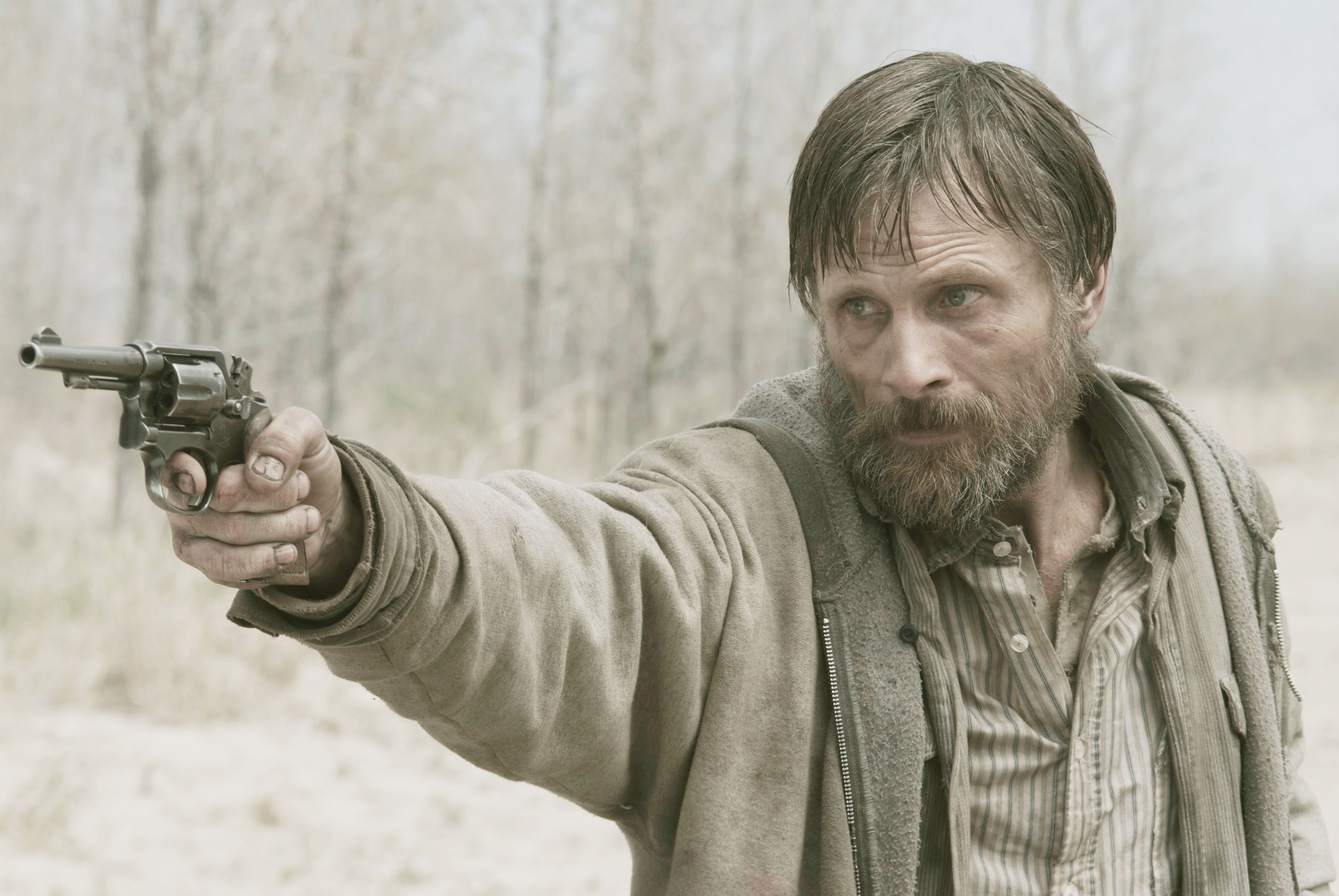
For lack of anything better to blog about I thought I would discuss another movie I saw that I believe is especially literary. No Country for Old Men is a film adaptation of none other then Cormac McCarthy's novel by the same name. Without giving too much away, the novel is about a hunter who comes upon a suitcase full of money and is then pursued by an ultra-psychotic killer. Their is so much more then that in the movie but I don't want to give anything else away. This movie is literary for many reasons. First, it doesn't hurt that it was based on a novel by Cormac McCarthy. I haven't read No Country for Old Men yet, but I'm sure it's of the same caliber as The Road. This movie can be very violent and entertaining at multiple points, but doesn't ever sacrifice quality for simple thrills. No Country for Old Men progresses unusually slowly for for such a graphic film in the beginning. This time is spent developing setting and characters to make the conflict between Llewelyn, the hunter, and Anton, the psychopathic killer, more meaningful for the audience. What really made this movie really stand out to me was the attention given to Anton. Anton is characterized as a being an unstoppable killing machine with no sense of morals or rules. He often decides whether or not his victims will live or die by simply flipping a coin. In his eyes, this is the only fair way to kill someone since they have the same chance of living as they dying. He also detaches himself from responsibility by stating how he can't control what side the coin will come up and by always respecting the results from the toss. The fact that he almost has principles and morals makes his character even more terrifying. Anton is someone who would leave a person's life up to chance and feel no responsibility for having to kill, or not kill, them. I would recommend definitely watching this movie since it's almost impossible to describe how deep and well constructed this character is.

Thursday, January 24, 2013

The Road vs The Walking Dead

The Road and The Walking Dead both fall into the category of post-apocalyptic stories focused around a small group survivors pitted against the horrors of a new world. These horrors can come literally in the physical form with zombies and cannibals; or from the struggle to find shelter and futility that comes from knowing that you can never truly rebuild civilization. Despite The Road being almost entirely literary in nature, and The Waling Dead leaning more towards commercialism, the two works can still be compared to see how certain elements from both of them overlap or stand alone.
 

The time period of the two works is never explicitly stated, but it is assumed they are in the foreseeable future. The Road is set against a bleak, infinitely grey backdrop, that resulted from some unknown natural disaster. The Walking Dead retains the beauty of the natural world at the expense of it being overrun by droves of zombies. Both are set in the American southeast. These two distinct settings provide for some of the key differences between The Road and The Walking Dead. The increasingly cold and hostile surroundings of the boy and the man require them to move towards the coast in hopes of warmer temperatures. However, they have little food and aren't even sure that the coast will provide the refuge that they desperately need. They are surrounded by the unseen enemy of nature, time, a limited food supply, and sects of cannibals stalking the land. There is always a slight undertone of futility in McCarthy's writing. He wants the audience to understand that even if the two reach the coast, life will most likely not improve for them. Having this constant sense of hopelessness contributes to the tone  while also making it evident that all the characters actions are most likely in vain. I felt this even at the end when the boy decides to continue with the veteran's group. I thought it was a relatively happy ending, but then I realized that they be lucky forever and keep finding countless supplies of food. This is almost never seen in The Walking Dead. Watching The Walking Dead, I never feel a sense of urgency or that everything may go wrong for all the characters. It's a great show and I love it, I just never feel scared for the characters like I do when reading The Road. I always know that despite what happens, most of the major characters in The Walking Dead will end up surviving any conflict. I think that the creators of The Walking Dead wanted to instill a sense of hope in their audience. The world may be overrun by zombies, but it isn't covered in permanent cloud of grey ash that has destroyed the natural world and left little possible hope for rebirth. Their is still a possibility that Rick and his group could establish a commune free from zombies, similar to what the Governor has. Some characters may die, but you always know that everything will be ok for the majority of the group. 

It may not have be fair to compare a novel to a TV show. The Walking Dead is more commercial which means the audience will want a happy ending. Whereas The Road is literary and can be as pessimistic and depressing as it wants.  The Road could have only been so long, but The Walking Dead can go on for as long as people continue to watch. This allows for more room for hope and rebirth since a show entirely about how depressingly awful life has become would not last long. However, not even Cormac McCarthy with all his prowess could create a character as developed and advanced as the lustrous T-Dog. 

Thursday, January 17, 2013

Fear and Loathing in Las Vegas

Fear and Loathing in Las Vegas was the first book I chose to read my inquiry project. It is difficult to describe exactly how I feel about this book since I'm not quite sure if I read it properly. I'll explain. This book is based on two trips that the author, Hunter S. Thompson, took to Las Vegas in the early 1970's. Thompson, a writer for Rolling Stone at the time, was supposed to chronicle a motorcycle race in the desert. But one thing led to another, and Thompson and his attorney instead decided to spend their time on mescaline, LSD, and whole other variety of illegal drugs.


“We had two bags of grass, seventy-five pellets of mescaline, five sheets of high powered blotter acid, a salt shaker half full of cocaine, and a whole galaxy of multi-colored uppers, downers, screamers, laughers... and also a quart of tequila, a quart of rum, a case of Budweiser, a pint of raw ether and two dozen amyls.
Not that we needed all that for the trip, but once you get locked into a serious drug collection, the tendency is to push it as far as you can.”


Fear and Loathing is not a non-fiction description of what happened, so it is sometimes hard to discern what really happened from story enhancing exaggerations. The book has no plot. It simply details the whimsical adventures that two seemingly ordinary men have when they tour Las Vegas on a myriad of drugs. The style of writing is amazing. His diverse use of syntax keeps the story moving at a fast, but understandable pace. The dialogue is interesting to say the least. Thompson uses a wide range of graphic language, and insults throughout, keeping the book fresh and fun to read. 
Thompson is having a bad acid trip and thinks everyone in the hotel lobby is a lizard who wants to eat him.

Thursday, January 10, 2013

The Road thoughts

I was very skeptical of this novel when I started reading it. I had already formed some preconceived notions about it based on the PowerPoint we saw about how awesome Cormac McCarthy is. Starting the book knowing that it had won the Pulitzer Prize and that the author is on of the greatest of the past several decades made my expectations extremely high. Needless to say, I was surprisingly disappointed after reading the first few pages. The sentences were short and often incredibly depressing. The dialogue was even worse. I couldn't believe that this amazing author used such simple sentences that were hardly more then 10 words, and seemed to have a blatant disregard for the laws of punctuation. But I read past these subtle annoyances and sporadic lack of apostrophes to try and find evidence that this author was all I had hyped him up to me. It took me to around page 55 to start to really the appreciate the unbelievable genius of this work. It was at this point in the story where a flashback details when the wife inevitably leaves the man and the child. I was expecting the dialogue at this point to change from its normal simplicity and become extremely powerful and emotional. Surely the discussion between a man and his wife as she is about to leave him and her child would be the perfect opportunity for McCarthy to show his mastery of literature, I thought to myself. Nope. The dialogue at this particular point was just as simple and direct as it had been throughout the beginning of the story. However, for some reason that I don't fully understand yet, this method was extremely effective at eliciting a response from me. This passage was probably the saddest, most emotionally rich phrase I have ever read. By making this section exceptionally simple McCarthy was able to not only surprise me but make me discover new found appreciation for his book. Another thing that I noticed is how the simple sentences started to really make sense and work with is style of writing. McCarthy doesn't ever tell the reader what they should be feeling during each point of the book. He is there to only describe the events that are happening to the man and the boy. For instance, at the scene where the man and the boy stumble on the cannibal victims in the basement, McCarthy never explicitly tells the reader that they should be terrified. He just describes the events exactly how they are happening and how a man a child would react to this horrific discovery. He makes the reader responsible for determining whether or not they should be feeling sad, terrified, or relieved. By not treating the audience like a child, and giving them some responsibility, McCarthy is able to leave his work open to interpretation and appeal to a more sophisticated group of readers. Overall, I have enjoyed reading this book so far. It has exceeded my expectations and left me appreciating this unique style of writing.