
Thursday, January 31, 2013
No Country for Old Men analysis
For lack of anything better to blog about I thought I would discuss another movie I saw that I believe is especially literary. No Country for Old Men is a film adaptation of none other then Cormac McCarthy's novel by the same name. Without giving too much away, the novel is about a hunter who comes upon a suitcase full of money and is then pursued by an ultra-psychotic killer. Their is so much more then that in the movie but I don't want to give anything else away. This movie is literary for many reasons. First, it doesn't hurt that it was based on a novel by Cormac McCarthy. I haven't read No Country for Old Men yet, but I'm sure it's of the same caliber as The Road. This movie can be very violent and entertaining at multiple points, but doesn't ever sacrifice quality for simple thrills. No Country for Old Men progresses unusually slowly for for such a graphic film in the beginning. This time is spent developing setting and characters to make the conflict between Llewelyn, the hunter, and Anton, the psychopathic killer, more meaningful for the audience. What really made this movie really stand out to me was the attention given to Anton. Anton is characterized as a being an unstoppable killing machine with no sense of morals or rules. He often decides whether or not his victims will live or die by simply flipping a coin. In his eyes, this is the only fair way to kill someone since they have the same chance of living as they dying. He also detaches himself from responsibility by stating how he can't control what side the coin will come up and by always respecting the results from the toss. The fact that he almost has principles and morals makes his character even more terrifying. Anton is someone who would leave a person's life up to chance and feel no responsibility for having to kill, or not kill, them. I would recommend definitely watching this movie since it's almost impossible to describe how deep and well constructed this character is.

Thursday, January 24, 2013
The Road vs The Walking Dead
The Road and The Walking Dead both fall into the category of post-apocalyptic stories focused around a small group survivors pitted against the horrors of a new world. These horrors can come literally in the physical form with zombies and cannibals; or from the struggle to find shelter and futility that comes from knowing that you can never truly rebuild civilization. Despite The Road being almost entirely literary in nature, and The Waling Dead leaning more towards commercialism, the two works can still be compared to see how certain elements from both of them overlap or stand alone.

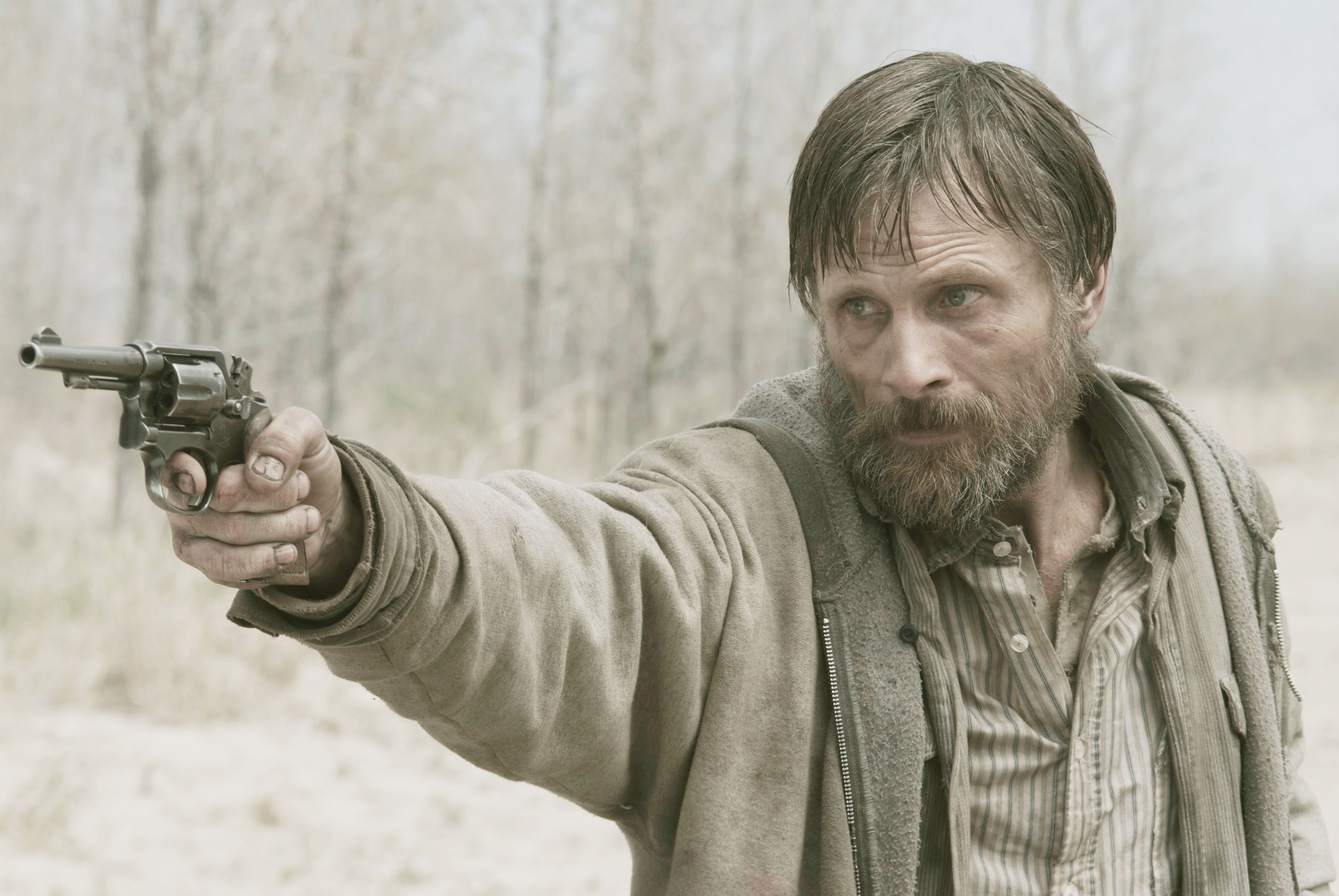
The time period of the two works is never explicitly stated, but it is assumed they are in the foreseeable future. The Road is set against a bleak, infinitely grey backdrop, that resulted from some unknown natural disaster. The Walking Dead retains the beauty of the natural world at the expense of it being overrun by droves of zombies. Both are set in the American southeast. These two distinct settings provide for some of the key differences between The Road and The Walking Dead. The increasingly cold and hostile surroundings of the boy and the man require them to move towards the coast in hopes of warmer temperatures. However, they have little food and aren't even sure that the coast will provide the refuge that they desperately need. They are surrounded by the unseen enemy of nature, time, a limited food supply, and sects of cannibals stalking the land. There is always a slight undertone of futility in McCarthy's writing. He wants the audience to understand that even if the two reach the coast, life will most likely not improve for them. Having this constant sense of hopelessness contributes to the tone while also making it evident that all the characters actions are most likely in vain. I felt this even at the end when the boy decides to continue with the veteran's group. I thought it was a relatively happy ending, but then I realized that they be lucky forever and keep finding countless supplies of food. This is almost never seen in The Walking Dead. Watching The Walking Dead, I never feel a sense of urgency or that everything may go wrong for all the characters. It's a great show and I love it, I just never feel scared for the characters like I do when reading The Road. I always know that despite what happens, most of the major characters in The Walking Dead will end up surviving any conflict. I think that the creators of The Walking Dead wanted to instill a sense of hope in their audience. The world may be overrun by zombies, but it isn't covered in permanent cloud of grey ash that has destroyed the natural world and left little possible hope for rebirth. Their is still a possibility that Rick and his group could establish a commune free from zombies, similar to what the Governor has. Some characters may die, but you always know that everything will be ok for the majority of the group.
It may not have be fair to compare a novel to a TV show. The Walking Dead is more commercial which means the audience will want a happy ending. Whereas The Road is literary and can be as pessimistic and depressing as it wants. The Road could have only been so long, but The Walking Dead can go on for as long as people continue to watch. This allows for more room for hope and rebirth since a show entirely about how depressingly awful life has become would not last long. However, not even Cormac McCarthy with all his prowess could create a character as developed and advanced as the lustrous T-Dog.
Thursday, January 17, 2013
Fear and Loathing in Las Vegas
Fear and Loathing in Las Vegas was the first book I chose to read my inquiry project. It is difficult to describe exactly how I feel about this book since I'm not quite sure if I read it properly. I'll explain. This book is based on two trips that the author, Hunter S. Thompson, took to Las Vegas in the early 1970's. Thompson, a writer for Rolling Stone at the time, was supposed to chronicle a motorcycle race in the desert. But one thing led to another, and Thompson and his attorney instead decided to spend their time on mescaline, LSD, and whole other variety of illegal drugs.
“We had two bags of grass, seventy-five pellets of mescaline, five sheets of high powered blotter acid, a salt shaker half full of cocaine, and a whole galaxy of multi-colored uppers, downers, screamers, laughers... and also a quart of tequila, a quart of rum, a case of Budweiser, a pint of raw ether and two dozen amyls.

“We had two bags of grass, seventy-five pellets of mescaline, five sheets of high powered blotter acid, a salt shaker half full of cocaine, and a whole galaxy of multi-colored uppers, downers, screamers, laughers... and also a quart of tequila, a quart of rum, a case of Budweiser, a pint of raw ether and two dozen amyls.
Not that we needed all that for the trip, but once you get locked into a serious drug collection, the tendency is to push it as far as you can.”
Fear and Loathing is not a non-fiction description of what happened, so it is sometimes hard to discern what really happened from story enhancing exaggerations. The book has no plot. It simply details the whimsical adventures that two seemingly ordinary men have when they tour Las Vegas on a myriad of drugs. The style of writing is amazing. His diverse use of syntax keeps the story moving at a fast, but understandable pace. The dialogue is interesting to say the least. Thompson uses a wide range of graphic language, and insults throughout, keeping the book fresh and fun to read.
Thompson is having a bad acid trip and thinks everyone in the hotel lobby is a lizard who wants to eat him.
Thursday, January 10, 2013
The Road thoughts
I was very skeptical of this novel when I started reading it. I had already formed some preconceived notions about it based on the PowerPoint we saw about how awesome Cormac McCarthy is. Starting the book knowing that it had won the Pulitzer Prize and that the author is on of the greatest of the past several decades made my expectations extremely high. Needless to say, I was surprisingly disappointed after reading the first few pages. The sentences were short and often incredibly depressing. The dialogue was even worse. I couldn't believe that this amazing author used such simple sentences that were hardly more then 10 words, and seemed to have a blatant disregard for the laws of punctuation. But I read past these subtle annoyances and sporadic lack of apostrophes to try and find evidence that this author was all I had hyped him up to me. It took me to around page 55 to start to really the appreciate the unbelievable genius of this work. It was at this point in the story where a flashback details when the wife inevitably leaves the man and the child. I was expecting the dialogue at this point to change from its normal simplicity and become extremely powerful and emotional. Surely the discussion between a man and his wife as she is about to leave him and her child would be the perfect opportunity for McCarthy to show his mastery of literature, I thought to myself. Nope. The dialogue at this particular point was just as simple and direct as it had been throughout the beginning of the story. However, for some reason that I don't fully understand yet, this method was extremely effective at eliciting a response from me. This passage was probably the saddest, most emotionally rich phrase I have ever read. By making this section exceptionally simple McCarthy was able to not only surprise me but make me discover new found appreciation for his book. Another thing that I noticed is how the simple sentences started to really make sense and work with is style of writing. McCarthy doesn't ever tell the reader what they should be feeling during each point of the book. He is there to only describe the events that are happening to the man and the boy. For instance, at the scene where the man and the boy stumble on the cannibal victims in the basement, McCarthy never explicitly tells the reader that they should be terrified. He just describes the events exactly how they are happening and how a man a child would react to this horrific discovery. He makes the reader responsible for determining whether or not they should be feeling sad, terrified, or relieved. By not treating the audience like a child, and giving them some responsibility, McCarthy is able to leave his work open to interpretation and appeal to a more sophisticated group of readers. Overall, I have enjoyed reading this book so far. It has exceeded my expectations and left me appreciating this unique style of writing.
Subscribe to:
Posts (Atom)